Need Help? Feel Free to Contact Us :

If hiring has slowed, shouldn’t recruiting be getting easier?
Not necessarily.
That is one of the more interesting contradictions developing across South Florida in 2026.
Employers are hiring more selectively. Professionals are changing jobs more cautiously. Employment growth has moderated from the extraordinary pace of the post-pandemic years
And yet, many companies are discovering that the professionals they most want to hire — experienced financial leaders, operators, HR executives, technology specialists, cybersecurity professionals, and other proven leaders — have not suddenly become easier or less expensive to recruit.
The issue isn’t simply a talent shortage.
South Florida increasingly has a talent liquidity problem.
Talent Supply and Talent Liquidity Are Not the Same Thing
Talent supply asks a relatively straightforward question: how many people have the skills we need? Talent liquidity asks the more important question: how many of those people are realistically willing and able to make a move? Those numbers can be dramatically different.
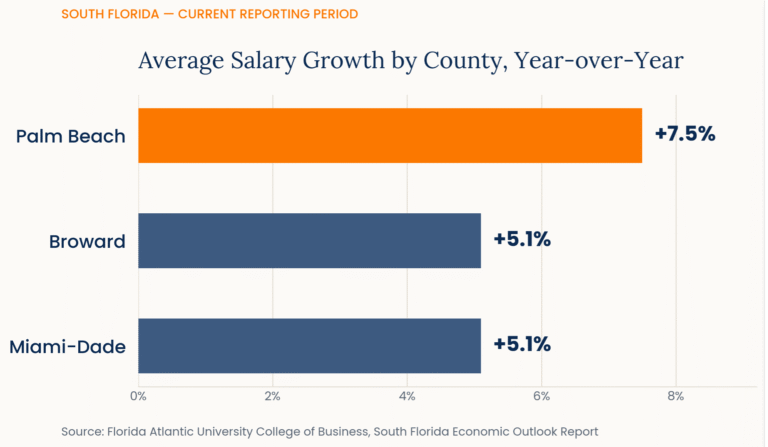
Florida Atlantic University’s South Florida Economic Outlook Report shows why. Employment growth across Miami-Dade, Broward, and Palm Beach counties has begun to flatten, while compensation continues to rise. Average salaries increased 7.5% in Palm Beach County and 5.1% in both Broward and Miami-Dade County year over year. FAU economist Dr. Bryan Cutsinger described the environment as less of a downturn than a “low-hire, no-fire” market: companies are hiring more cautiously, but they are also holding on to the people they already have.
That creates an unusual recruiting environment. There may be more professionals willing to have a conversation. There are not necessarily more exceptional professionals willing to leave a good job.
The Best Candidates Have More Reasons to Stay Put
When uncertainty rises, the risk calculation associated with changing jobs changes with it.
A successful executive or professional who is well compensated, trusted by leadership, and established within an organization may view a new opportunity very differently today than during the hiring acceleration of 2021 or 2022.
The decision becomes broader than salary: How credible is the leadership team? How strong is the business? Is the mandate clearly defined? What is the real growth opportunity? How much flexibility exists? Is the commute sustainable? Does the move improve the individual’s long-term career trajectory enough to justify the risk?
A candidate being open to a conversation should never be confused with a candidate being ready to accept an offer.
For employers, that distinction is critical. The threshold required to move high-performing talent has risen.
The Headline Labor Market Can Be Misleading
An unemployment rate tells us something important about an economy. It tells a hiring manager considerably less about the availability of a very specific executive or professional profile.
A company may need a finance leader who has operated in a private-equity environment, led a transformation, and understands acquisitions. Another may need a controller combining industry knowledge, systems expertise, and operational leadership. Another may need a technology executive capable of translating cybersecurity, automation, and data strategy into business outcomes.
Each additional requirement changes the true size of the candidate market. Companies do not hire unemployment rates — they hire combinations of experience. And the more specialized the combination, the smaller the genuinely qualified, and genuinely movable, candidate pool becomes. That distinction is at the heart of the talent-liquidity problem.
There Is No Single “South Florida Talent Market”
Another mistake is treating South Florida as though it were one interchangeable labor pool. Economically, Miami-Dade, Broward, and Palm Beach are closely connected. From a candidate’s perspective, they can be very different markets.
A professional living in Boca Raton may technically fall within the geographic radius of a Brickell search. That does not mean that individual considers a five-day-per-week commute practical. The reverse is equally true.
As organizations continue refining their in-office, hybrid, and flexible-work strategies, location increasingly becomes part of the compensation equation. An office address, parking situation, required number of days onsite, and expected commute can materially change the effective candidate pool — even if the salary never changes. For specialized and executive searches, geography can therefore eliminate excellent candidates from an already limited market.
Miami-Dade, Broward, and Palm Beach Aren’t Moving in Lockstep
The latest regional data reinforces another point: broad descriptions of the South Florida market can conceal important differences between counties and industries.
FAU reported that Miami-Dade’s finance and insurance sector grew approximately 4% in employment year over year, while wages in that sector increased 9.8%. During the same period, finance and insurance employment declined in Broward and Palm Beach counties.
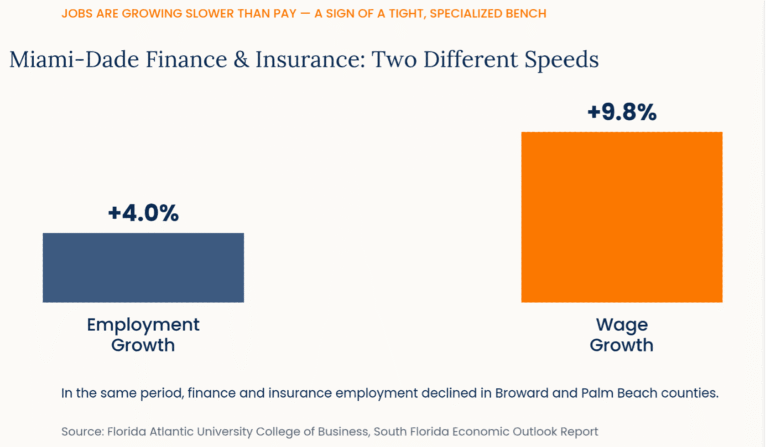
That does not mean financial services are disappearing from those markets. It means something more useful to business leaders: South Florida is not one homogeneous labor market. Different industries, functions, and counties are adjusting at different rates.
Statements such as “the market is soft,” “there are plenty of candidates now,” or “everyone wants to move to South Florida” are therefore not particularly useful without context. They may be directionally true somewhere while being completely wrong for a specific search.
Selectivity Has Increased on Both Sides of the Table
The market is becoming more selective in two directions. Employers are scrutinizing candidates more closely because important hires must increasingly demonstrate measurable business value. Candidates are scrutinizing employers more carefully because leaving a secure position must create measurable career value.
That is widening one of the most important gaps in executive and professional recruiting: the distance between qualified and hireable.
A résumé may match the job description beautifully. That doesn’t mean the compensation will work. The geography may fail. The mandate may be insufficient. The candidate may expect equity. The organization may need someone who has already completed a transformation rather than someone who has simply participated in one. Or the market may reveal that the ideal profile does not exist at the compensation level the company originally budgeted.
Those are not sourcing problems. They are talent-strategy problems.
The Best Hiring Strategies Begin Before the Search
Companies navigating this environment should resist the temptation to solve difficult searches by simply interviewing more people. Volume does not correct a poorly calibrated talent strategy.
Before a critical search begins, leadership should be able to answer five questions: What business problem must this person solve? Which qualifications actually predict success? Where does that talent realistically live? What would cause a successful professional to leave an already successful situation? And what does the external market indicate that combination of experience is worth?
This is where market mapping becomes considerably more valuable than simply posting a job. Organizations that understand the talent universe before entering it can adjust compensation, location, specifications, and expectations before losing weeks interviewing candidates who were never realistically attainable.
There Is a Message Here for Candidates, Too
A more selective hiring environment requires senior professionals to change their strategy as well. This is not an ideal market for relying solely on high-volume applications.
Mid-career and executive-level professionals increasingly need to articulate the business value behind their experience — not simply what they were responsible for, but what changed because they were there. What improved? What was built? What was transformed? What became faster? What became more profitable? What risk was reduced? What capability was created? What talent was developed?
That distinction becomes even more important as technology and AI change how functions operate. Senior leaders do not all need to become technologists. They do need enough technology fluency to understand how data, automation, and AI may improve the functions they lead — from forecasting and reporting to recruiting, operations, customer experience, and decision-making.
South Florida Has Entered a More Sophisticated Talent Market
A slower hiring market should not be confused with an easy hiring market. South Florida’s next phase may actually require greater recruiting precision, not less.
Companies are more selective. Professionals are more cautious. Compensation remains competitive in important parts of the market. Geography matters. Office expectations matter. Career trajectory matters. And many of the specialized combinations of experience employers require are concentrated among people who are already successfully employed.
So perhaps the most useful question for an employer today is no longer “How many candidates are out there?” It is: “How much of the right talent is actually available to us — and what will it take to move them?”
That is the question that increasingly separates organizations that simply recruit from organizations that build the leadership and professional teams required to execute their strategy.
About phoenix Pro Connect
phoenix Pro Connect partners with organizations across South Florida and nationally on executive search, professional recruitment, interim and project talent, and contract-to-hire solutions across accounting and finance, technology, human resources, operations, and executive leadership.
Our work goes beyond identifying candidates. We help organizations understand the talent market, define the right profile, evaluate candidate availability, and develop recruiting strategies grounded in the realities of the market.
For organizations evaluating an important hire — or professionals considering the next chapter of their careers — we welcome a confidential conversation.
Sources
This briefing draws on the Florida Atlantic University College of Business South Florida Economic Outlook Report and related FAU reporting on the tri-county labor market, supplemented by national commentary on current U.S. hiring conditions.
• Florida Atlantic University College of Business — South Florida Economic Outlook Report: https://business.fau.edu/south-florida-economic-report
• FAU News — “FAU Report: South Florida Economy Stays Robust Despite National Challenges” (2026): https://business.fau.edu/newsroom/press-releases/2026/fau-report-south-florida-economy-challenges-national.php
• Federal Reserve Bank of Cleveland — “The ‘Low-Hire, Low-Fire’ Labor Market” (national context for current hiring conditions): https://www.clevelandfed.org/publications/economic-commentary/2026/ec-202617-the-low-hire-low-fire-labor-market
• U.S. Bureau of Labor Statistics, Southeast Information Office — County Employment and Wages in Florida: https://www.bls.gov/regions/southeast/news-release/countyemploymentandwages_florida.htm